
RONDO KRAKÓW
KS Cracovia Centennial Hall
Disabled Sports Center
Miroslaw Baca’s Sculpture Exhibition
Concert
Butoh
We are including the Disabled Sports Centre in our activities in the field of Culture
KS Cracovia Centennial Hall
Disabled Sports Center
October 10th, 2026
A Krakow sculptor, a Krakow composer, and young musicians from Krakow present an interdisciplinary project that includes an exhibition of sculptures installed on the building of the KS Cracovia Centennial Hall and a classical music concert featuring the performance of a work created for the project.
The “Rondo Kraków” project combines sculpture, music, education, and international exchange of experiences. This ambitious cultural event promotes Krakow artists in a space dedicated to sports and people with disabilities.
A Butoh Etude with the participation of artists with disabilities is a key element of this ambitious artistic event. The dance performance prepared by workshop participants at the Disabled Sports Center is both the goal and the result of the combined project “BUTOH Etude, Workshop, and Performance.”
A Butoh performance featuring people with disabilities becomes an event accompanying an exhibition and concert led by professional artists. The participation of artists with disabilities in a cultural event and their collaboration with professional creators is a mutually beneficial experience based on synergy and inclusiveness.

Project co-financed by the City of Krakow

The project was implemented with the financial support of the Małopolska Voivodeship
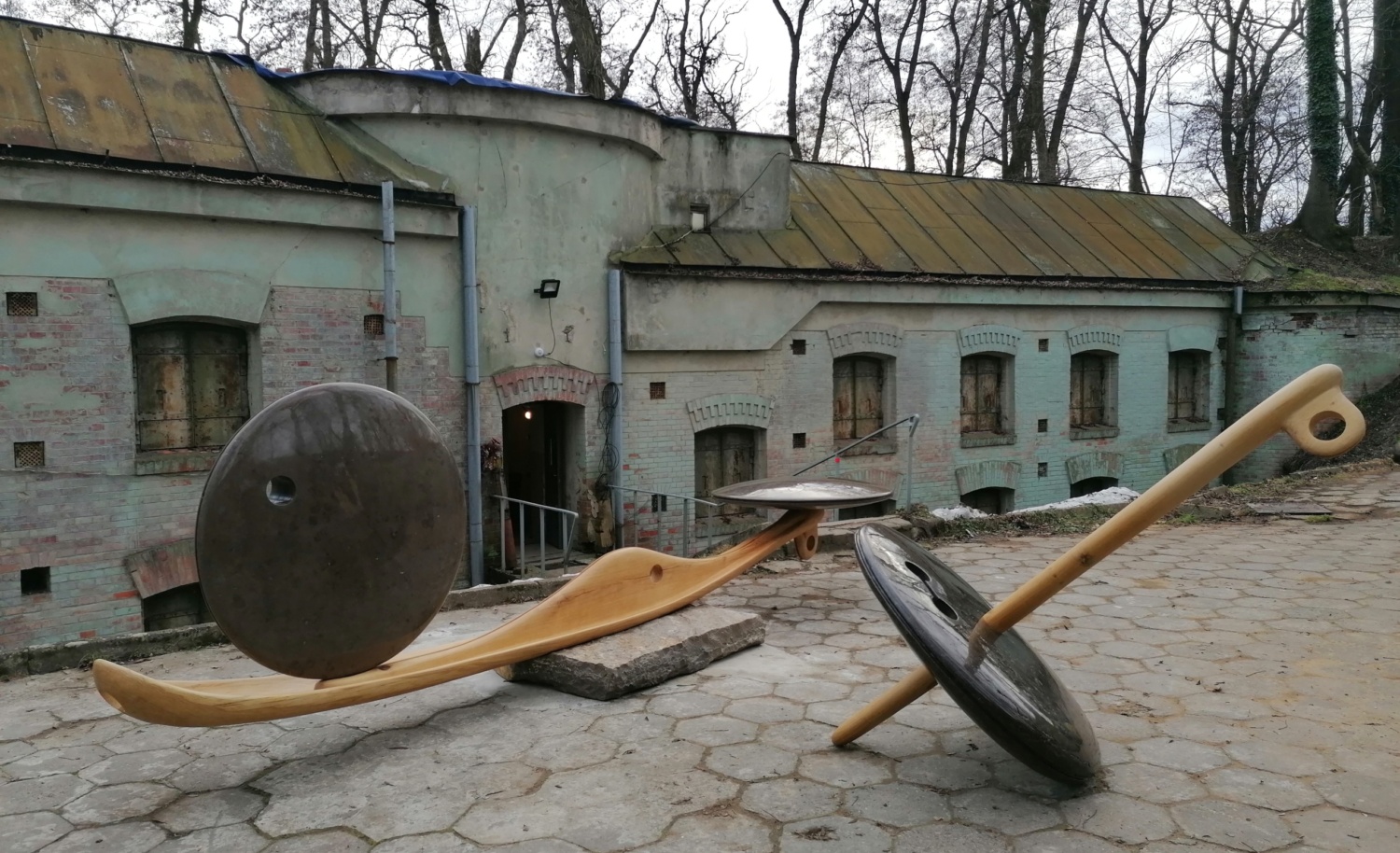
Sculptures by Krakow sculptor Mirosław Baca, created during an artist residency in Switzerland in 2024, are presented in Krakow for the first time, completing a project previously presented at both the Manggha Museum of Japanese Art and Technology (2024) and the Karol Szymanowski Philharmonic in Krakow (2025). The exhibition consists of two hanging marble abstract sculptures, “Ticino Duetto,” and a composition of marble and wooden elements from the “Rondo Kraków” sculpture, created in 2024. His latest work is “Sudecka Cantata,” created in 2026 thanks to the artist’s collaboration with HP Stone from Rybnica Leśna near Wałbrzych. Precision, tension, rhythm, and balance are key concepts for the presented sculptural composition. It is a visual and spatial demonstration of the emotions and experiences of the creators, performers, and, above all, music listeners. It does not refer to specific musical works, but rather to the structure, formal aspects, and emotional substrate of the music itself. The complete project is a composition composed of several segments, alluding to individual sections of a symphony orchestra. Through the correlation of size, the tension of form, the juxtaposition of natural materials, the balance of weight, the play of ornament, and the introduction of openwork elements, the presented sculptures invite participation in a shared space. The viewer, once inside, becomes a part of it and an integral element of the work. The relationship between the viewer and the material, the connection between space and the work, and the reception of sculpture that inclines the viewer’s formal participation are the design principles and the focal point of Mirosław Baca’s creative endeavors. The process of searching for form, striving to achieve the maximum and ultimate potential of the material, and his focus on detail, quality, and precision of finish, have made classical music, of which he has always been an admirer, an important source of inspiration, appropriate in its form to his assumptions and explorations as a sculptor. He desires to be the composer of space, and the sculpture an instrument, a component thereof. The arrangement and interdependence of modules constitute a kind of musical score, while their arrangement constitutes performance, interpretation, and playing: “The visual and aesthetic aspect of music becomes the most exciting for me. Listening to a piece, I simultaneously feel it and observe it. The concentration and precision of execution, the collaborative nature and close filiation of numerous elements, the detail, the natural material of the instruments combined with the skill of both the luthier and the musician, the associations of shape and movement with sound, the complexity and processual nature of these are the qualities of a musical work that I wish to translate into sculptural format, to create a three-dimensional and visual space of music.” The concert includes the performance of a musical work for soprano, flute, accordion, cello and percussion by Karol Osman, titled “Rondo Kraków” and created especially for the project in 2025. The musical composition “Rondo Kraków” by Karol Osman is a work created as part of a compositional commission. The premiere of the work, accompanying an exhibition of sculptures, took place at the Karol Szymanowski Philharmonic in Krakow on September 25, 2025. The young musicians invited to the project have strong ties to Krakow, and the project itself is also an opportunity to support and recognize the younger generation of musicians. Composer Karol Osman is also the author of the “Podgórze Bugle Call,” created as part of the celebrations of the 110th anniversary of the city’s reunification with Krakow. “Rondo Kraków” is a musical composition for soprano, flute, accordion, cello, and percussion inspired by the sculptures of Mirosław Baca, particularly the sounds associated with the process of working on a sculpture, such as the sounds of a chainsaw, cranes, the rhythm of chisel strikes, falling splinters, shavings, splitting wood, and the artist’s physical exertion. The interplay between sculpture and musical composition exists not only in the inspirational process of creating the sculptures but is also reflected in the piece’s formal structure, based on repeated motifs, repetitive passages, and arching musical ideas. The piece draws on the rondo form, which has its roots in the 14th-century music of medieval Europe. The composer’s juxtaposition of the music, which combines contemporary performance techniques with historical musical form, provides an opportunity for reflection and a confrontation between the past and the present. The project also includes organizing Butoh workshops for people with disabilities (mobility and/or vision limitations), their caregivers, and interested participants of all ages, led by professional artist Anita Zdrojewska, and the collaborative preparation of a short piece to be presented at a planned artistic event. The artist will also present her own program accompanied by music by Ruff Libner. Butoh dance emerged in Japan in the 1950s. It was a response to the postwar identity crisis of the Japanese people and the fruit of a search for a way to liberate the body from routine, choreographed movements, as well as from established canons of beauty. Its founders were Tatsumi Hijikata (1928–1986), who recognized the body in its entirety—with its beauty and imperfections—and Kazuo Ohno (1906–2010), who believed that “in dance, the spirit guides.” Initially working within the modern dance movement, seeking a way to liberate the body from choreographed movements and established canons of beauty, they created an entirely new, distinctive kind of dance and performance practice. Butoh is a free-form dance – a creative exploration, working with the body and emotions, and an opportunity to release tension. There are no standards for “correct movement.” Under the influence of music, the instructor’s voice, or the illustrations shown, participants are inspired and explore their own dance. The workshops are intended to be inclusive – also open to caregivers – and the intensity level will be adapted to the participants. The prepared performance will be inspired by the sculptures on display (the “Rondo Kraków” project), with a particular focus on the material. The sculptures also become a choreographic link. In the dance, the artists will focus particularly on the material that has been sculpturally processed. Trees and stones, constituting the natural environment, have accompanied humanity for centuries, becoming silent witnesses to events; the stories contained within their layers are both inspiration and a choreographic link, connecting the past with the present. They come alive in the dancers’ movement and the accompanying, purposeful music: Ruff Libner is a virtuoso of one of the oldest wind instruments in the world – the didgeridoo. Program: Mirosław Baca: Sculpture Exhibition “Rondo Kraków”, “Ticino Duetto”, “Kantata Sudecka” Karol Osman: „Rondo Kraków” With: Edyta Matonóg – cello Adrianna Mętel – flute Krzysztof Madyda – accordion Karolina Ładoś – marimba, percussion Annika Mikołajko-Osman – soprano, rhythm bones, Tibetan bowls Anita Zdrojewska: Performance BUTOH Music: Ruff Libner Butoh etude performed by workshop participants Galeria
Partners



Links
