
TRADICIÓN Y CULTURA VIVA EN EL SUR DE MÉXICO
Tradition and Living Culture of Southern Mexico
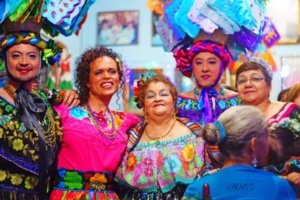
A colorful dance procession through the streets of the Old Town of Krakow and a Fanadango fiesta in the Small Market Square. Dancers in women’s folk costumes and live music. A fusion of folk art and queer subculture.
The project includes a visit to Krakow by artists and representatives of cultural organizations from Mexico and their active participation in events of the Fair of Borderland of Cultures organized annually in the Small Market Square in Krakow.
Mexico will join the international movement in Krakow with a visit by a cultural delegation from two distinct regions: Tlacotalpan in Veracruz and Chiapa de Corzo in Chiapas. Both regions are distinguished by the diversity and vitality of their cultural expressions, deserving of inclusion on the UNESCO World Heritage List.
Under the theme “Tradition and Living Culture in Southern Mexico,” the Mexican delegation proposes a program of events during the Fair of Cultural Borderlands, including exhibitions, experimental workshops, discussions, musical performances, and shared celebrations. This program will enrich the event’s cultural offerings through the active engagement of a diverse audience, both from Krakow and visitors to the city. It fosters intercultural exchange and dialogue on shared issues such as heritage preservation, the recognition of diverse identities, and the visibility of different models of cultural governance.
Promoting Mexican culture by sharing its diversity and vitality through an event of international significance is the implementation of a cultural strategy that will significantly strengthen relations between Mexico and Poland, using the universality of art and cultural expressions as a tool for building more inclusive and cohesive societies, as well as forging bonds between individuals, people, and nations.
22. Kiermasz Pogranicza Kultur / 22th Fair of Borderland of Cultures
Mały Rynek, Kraków
October 15 – 23, 2026

Project co-financed by the City of Krakow
Mexico is a multicultural country, the cradle of great civilizations that have left a profound legacy in their languages, customs, rituals, artistic expressions, and folk crafts. This mosaic of roots and fusions lives on in the daily lives of its inhabitants and the symbolic power of tradition. Two cities connected by water that embody this richness are Chiapa de Corzo on the banks of the Grijalva River and Tlacotalpan on the banks of the Papaloapan River; both enjoy international recognition for their historical and cultural significance. The Fair of Borderlands of Cultures in Krakow offers a unique opportunity to showcase these values and connect with an international audience through a cross-cultural exchange, providing an opportunity to learn about diversity, discover connections between distant cultures and realities, and strengthen friendships between nations. Participation in the Fair will showcase not only artistic works of high aesthetic and social value, but also communal experiences that make culture a tool for inclusion and the building of collective identity. The delegation from Chiapas and Veracruz presents a comprehensive program of participatory activities combining exhibitions, workshops, discussions, musical performances, and folk celebrations, based on the belief that tradition is also a living heritage, constantly transforming within communities, and when shared internationally, it acquires universal significance. Jarocho and fandango music, and the chuntás dance with its ritual and festive costumes, are local forms of expression that, when presented in Krakow, will draw on the richness of Polish and European folk art, creating a space for encounters between artisans, artists, cultural organizers, researchers, youth, and families from around the world. DESCRIPTION OF THE DELEGATION PARTICIPANTS AND THEIR ARTISTIC ACTIVITIES MARIO CRUZ TERÁN is a visual artist, documentary photographer, and community cultural mediator. A graduate of the Faculty of Fine Arts at the University of Veracruz, he complemented his academic training with international exchanges at the University of Houston–Clear Lake in the USA and at the Academy of Fine Arts and Design in Bratislava, Slovakia. Since 2005, he has lived in Tlacotalpan, Veracruz, where he develops projects documenting, preserving, and disseminating the cultural heritage of the Sotavento region. He co-founded Foro Cultural Luz de Noche (Forum Cultural Luz de Noche), an independent platform from which he promotes initiatives in cultural management, artistic training, and community empowerment. Through this forum, he has been promoting traditional fandango as a space for gathering, transmitting knowledge, and preserving Veracruzian culture for almost two decades. LORENA IVONNE REYES GUEVARA is a potter, sculptor, and community cultural mediator. A graduate of the Faculty of Fine Arts at the University of Veracruz, specializing in sculpture, she has participated in symposia, exhibitions, and international art events in various cities in Mexico, France, and Serbia. Since 2007, she has lived in Tlacotalpan, Veracruz, where she promotes the preservation of cultural heritage and community empowerment projects. She is co-founder of the Luz de Noche Cultural Forum, director of the Tinajeril Ceramic Art Museum (MOAT), and coordinator of the Tlacotalpan Traditional Ceramics Revitalization Project. Through art, education, and cultural management, she promotes the preservation of local knowledge, living culture, and the biocultural heritage of the Sotavento region. JOSÉ DOMINGO FLORES SALDAÑA is from Tuxtla Gutiérrez, Chiapas, Mexico. He studied visual arts and is an active member of the Zoque and Chiapaneca traditional music and dance communities. His work has been exhibited in various venues in Mexico, Houston, Texas, USA, and Tokyo, Japan. He is dedicated to documenting, promoting, and teaching knowledge related to Chiapas traditions, such as the music, dance, and costume design of the Chiapaneca and Chuntá peoples of Chiapa de Corzo. PROFILE OF PARTNER ORGANIZATIONS The Civic Association for the Protection of Biodiversity, Medio Ambiente y Cultura Popular CUSBIOMAC A.C. (Custodia por la Biodiversidad, Medio Ambiente y Cultura Popular CUSBIOMAC A.C.) is a non-profit civic organization based in Tlacotalpan, Veracruz, that develops, manages, and implements projects that integrate environmental education, tradition, art, and social participation. Its goal is to promote a culture of sustainable development that contributes to the regeneration of the socio-cultural fabric necessary to achieve the preservation and protection of the natural, tangible, and intangible heritage in the lower Papaloapan basin. The Organization operates under the principle that sustainable development is based on local, collaborative, and ongoing action that promotes the preservation of traditional knowledge, strengthens regional identity, and promotes culture as a tool for social transformation. It is part of national networks of civil society organizations, actively participating in initiatives related to land management, the sustainable management of biocultural heritage, and environmental protection. The most important achievements of the team include: the creation of the Luz de Noche Cultural Forum, the project “Restoration of the natural mangrove area in the La Cerca lagoon” and the project “Saving the traditional pottery craft in the lower reaches of the Papaloapan River”, the establishment of the MOAT Pottery Craft Museum in Tlacotalpan. Founded in 2005, the Luz de Noche Cultural Forum was the first independent, self-governing cultural institution in Tlacotalpan, Veracruz. It was created in response to the need for expression, education, recreation, and socialization through art by diverse social groups, as well as by visitors to this UNESCO World Heritage Site. Since then, the forum has consistently worked to create and promote recreational and educational cultural offerings aimed at transforming traditional ways of producing and enjoying cultural goods and services and fostering more creative, diverse, inclusive, and collective practices. Its activities include organizing cultural programs, exhibitions, film screenings, workshops, and artistic performances that strengthen local identity and encourage dialogue between traditionalists, contemporary artists, and the general public. Luz de Noche has established itself as a meeting place and center for exchange between the creative, artistic, and academic communities, as well as between musicians and promoters of Son Jarocho. It is a space of collective creation where voices, sounds, projects, and life experiences converge around music and the stage – symbols of sociability and shared celebration. Today, it is recognized as a national leader in disseminating cultural expressions from the Sotavento region and promoting projects that combine artistic creation with the preservation of intangible heritage, contributing to the development of socially active individuals who are aware of their history and engaged in cultural heritage. SOCIAL SIGNIFICANCE, HISTORY AND TRADITION Mexico, a multicultural and multilingual country that was subjected to Spanish invasion for three centuries, was the source of magnificent cultures that left us a magnificent legacy. These survive in our languages, costumes, customs, festivals, and rituals, which manifest our fusion and religious syncretism. A space was created for diverse expressions of dance and music. Located in the lower Papaloapan River basin, in the southern state of Veracruz, Tlacotalpan, a pre-Columbian town that became a key point of colonial trade in the 18th century and the country’s first deep-sea port, stands out for its unique urban layout, colorful houses with wide portals and tiled roofs. It is a jewel of vernacular architecture that was designated a UNESCO World Heritage Site in 1998. Throughout its history, it has been the cradle of cultural expressions that are part of the soul of Veracruz: the jarocho, the fandango, the décima espinela, carpentry, woodworking, violin making, and pottery. During festivals like La Candelaria, faith, music, and community life intertwine, reaffirming the jarocho identity and a sense of belonging to the southern territories. Traditions are passed down from generation to generation. The Tlacotalpan cultural delegation is composed of musicians, dancers, writers, and artists, founders of various initiatives and cultural spaces. Through teaching traditional music, intergenerational coexistence, the recovery of ancestral crafts, and the exchange of knowledge and artistic expression, they respond to the needs and shortcomings of their community, nurturing and strengthening the roots of the social fabric. Their goal is to sustain, transmit, and protect their tangible and intangible heritage. As part of the Fair of Borderlands of Cultures in Krakow, these experiences will merge into a ritual celebration around the stage, sharing and setting the pace for new encounters, reflecting the power of collective work, and celebrating different ways of building life. Son jarocho and Fandango Son jarocho is a mestizo musical genre with Afro-Indian and Spanish roots that developed in the 18th and 19th centuries, when the maritime and river shipping routes and royal roads connecting the Sotavento region – a vast cultural area connecting Veracruz, Oaxaca and Tabasco – served as arteries of colonial trade, through which circulated goods, natural resources, people and stories, rhythms, sounds and instruments from Africa, Europe and Native America. Its formation within this sociocultural framework makes it an incredibly diverse phenomenon, whose melodies, poetics, and rhythms vary from place to place, reflecting the cultural characteristics and specificities of the inhabitants of the various regions of Sotavento. It is a music composed of a dialogue between percussion instruments such as the jarana, requinto, leona, the jarocha harp, pandero, marimbola, and quijada de burro. Its structure combines musical improvisation with popular poetry, in verses that typically take the form of décimas espinelas or quatrains. These verses explore themes ranging from love, everyday life, and the relationship between humans and nature to current issues of social criticism. This interpretative flexibility and its collective nature make it a living language, constantly evolving depending on its social and cultural environment. The fandango, in turn, is the social heart of Son jarocho. It is a communal celebration that gathers musicians, dancers, and poets around a stage, where rhythm, words, and movement intertwine in a shared dialogue. Beyond its festive dimension, the fandango serves as a space for learning, oral communication, and intergenerational integration, strengthening community identity and bonds of belonging. In recent decades, its revitalization has strengthened the practice of Son jarocho through processes of cultural self-governance and social education, positioning it as a symbol of resistance and social cohesion in southern Mexico. La Chuntá (La pandilla de la Tía They) Traditional dance from Chiapa de Corzo, Chiapas In southern Mexico, on the banks of the Grijalva River, lies Chiapa de Corzo, a mestizo town of Chiapa origin. The most important festival is celebrated in January. It honors San Sebastián Mártir and other Catholic saints, who are offered traditional dances, including the chuntá—dances announcing the great Chiapa festival and performed by men dressed as women, accompanied by drums and pito (reed flutes). Chuntá meet in different neighborhoods around the town. They call themselves gangs. One of the most well-known groups is that of Doña Esther Noriega (Pandilla de la Tía They), a visionary who, after experiencing homophobic and transphobic discrimination, decided to form her own gang as a safe, free, and inclusive space. Pandilla de la Tía They is offering a series of presentations to mark their visit to Krakow. They will present dance, music, workshops, a photography exhibition, and artifacts from the chuntá and Chiapas ethnic groups. Galery

Partners
Links
